
No Support for Bumrah! Inexperienced Indian Bowling Attack Struggles as New Zealand Finish Day One in Command
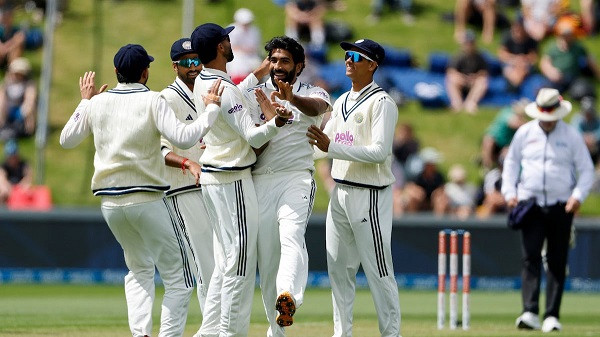
IIE DIGITAL DESK ; Wellington, November 19: India began the opening day of the Test match at Wellington's Basin Reserve in commanding fashion, with Jasprit Bumrah once again demonstrating why he remains one of the most dangerous fast bowlers in world cricket. The close of play, the momentum had shifted dramatically in New Zealand's favour. A remarkable unbeaten partnership between Henry Nicholls and Glenn Phillips rescued the hosts from a disastrous position and put India under considerable pressure. New Zealand finished the first day at 243 for five, with Nicholls unbeaten on 113 and Phillips approaching his maiden Test century at 94 not out.
The opening conditions appeared perfectly suited to India's pace attack. The Basin Reserve pitch had around 15 millimetres of grass, while strong winds offered additional assistance to the fast bowlers. Indian captain Shubman Gill had little hesitation in choosing to bowl first after winning the toss, and Bumrah immediately justified his decision with a sensational opening spell.
New Zealand captain Tom Latham was dismissed in the very first over, with Bumrah producing a delivery that moved sharply back into the batter and crashed into his off stump. Latham appeared to believe that the ball would move away from him and chose not to play it, only to be beaten by Bumrah's movement.
India continued to make early inroads. Devon Conway was caught behind by Rishabh Pant off Anshul Kamboj, while Rachin Ravindra departed after offering a catch to Pant off Akash Deep. The hosts were suddenly struggling, having lost three important wickets in quick succession. Bumrah then delivered another major blow by dismissing Daryl Mitchell, who was caught by Yashasvi Jaiswal.
The pressure intensified further after lunch when Bumrah removed Tom Blundell for just five runs. Gill took the catch in the slips, leaving New Zealand reeling at 70 for five. At that stage, India's decision to bowl first seemed to have been a masterstroke. The ball was swinging, the pitch was offering assistance and New Zealand's batting order appeared unable to withstand the Indian pace attack.
India had entered the match with four specialist fast bowlers, relying on Bumrah, Prasidh Krishna, Anshul Kamboj and Akash Deep. Mohammed Siraj and Ravindra Jadeja were left out of the playing XI, with Jadeja's omission attracting particular attention. New Zealand's left-handed batting combination at the top may have influenced the selection decision.
The game changed dramatically as Henry Nicholls and Glenn Phillips began rebuilding the innings. Nicholls, who had walked out to bat in the opening over, watched four of his teammates return to the pavilion. Batting at number three in the absence of Kane Williamson, he faced the enormous responsibility of preventing a complete collapse.
His previous record against India had not been particularly impressive. Across six earlier Test appearances against India, he had managed an average of just 13.55, with 44 being his highest score. But on this occasion, Nicholls displayed remarkable patience and determination.
He initially survived a close appeal against Bumrah when the on-field umpire raised his finger following a possible catch behind the stumps. Nicholls reviewed the decision and successfully overturned it. Thereafter, he focused on building his innings carefully, leaving deliveries outside off stump, defending when necessary and punishing loose balls whenever opportunities arose.
The other end, Glenn Phillips adopted a contrasting approach. He counterattacked from the beginning, refusing to allow Indian bowlers to settle into a comfortable rhythm. The pair rotated the strike effectively and repeatedly converted singles into doubles and doubles into threes, forcing Indian fielders to cover considerable ground.
The day progressed, the pitch gradually lost its moisture and the ball became less effective in generating movement. The conditions that had helped Bumrah dominate the opening session were no longer available to the same extent. Prasidh Krishna struggled to maintain his line and length, conceding 35 runs in his first eight overs. Kamboj managed to keep the scoring relatively controlled but could not add to India's wicket tally, while Akash Deep also failed to create further breakthroughs.
By the tea interval, New Zealand had recovered to 140 for five, with Nicholls batting on 66 and Phillips on 42. Their partnership had already reached 70 runs, and the Indian attack was beginning to lose its early dominance.
The final session proved even more frustrating for India. Phillips increased the attacking tempo, using his feet against the spinners and finding boundaries at crucial moments. Nicholls, meanwhile, continued to display excellent judgement outside the off stump and avoided unnecessary risks.
India were handed an important opportunity to break the partnership when Nicholls was batting on 102. He attempted to pull a short delivery from Prasidh Krishna towards backward square leg, but the ball went towards the fielders. Rishabh Pant and Devdutt Padikkal both moved towards the catch, resulting in a costly misunderstanding. Padikkal ultimately failed to hold on to the opportunity, allowing Nicholls to continue his innings.
The dropped catch proved particularly expensive. Nicholls went on to complete his 12th Test century, marking his first Test hundred against India. Coming just four days after his 35th birthday, the innings was a special achievement for the New Zealand batter.
His century also strengthened his impressive record at the Basin Reserve. It was his fifth Test hundred at the Wellington venue, bringing him level with John Wright and Brendon McCullum in terms of centuries at the ground. Nicholls also became the sixth batter to reach 1,000 Test runs at the venue, where he boasts an outstanding average of 85.25.
Phillips deserves equal credit for New Zealand's recovery. Unbeaten on 94 at stumps, he combined aggressive stroke play with sensible shot selection and kept the pressure firmly on the Indian bowlers. His maiden Test century now appears within reach, and India will be desperate to prevent him from reaching the landmark when play resumes on Friday.
The three sessions of the opening day told three completely different stories. New Zealand lost four wickets for 60 runs in the first session. They added another 80 runs while losing just one wicket in the second session. In the final session, Nicholls and Phillips completely dominated the proceedings, scoring 103 runs without losing a wicket.
The bowling statistics also highlighted India's difficulties. Indian pacers claimed two wickets for 67 runs through full-length deliveries, while good-length bowling produced three wickets for 50 runs. However, short-pitched deliveries failed to generate any breakthrough. India conceded 77 runs from 122 short balls, indicating that the strategy did little to trouble the established New Zealand partnership.
The lack of experience in India's bowling attack was another major talking point. Bumrah was the only bowler in the playing XI with 50 or more Test wickets to his name. The remaining bowlers had a combined total of just 102 Test wickets. While Bumrah successfully created enormous pressure during his spells, the other bowlers struggled to maintain the same intensity after his spells ended.
The situation has inevitably brought back memories of India's historic Gabba Test victory during the 2020-21 season. India had also entered that contest with an inexperienced bowling attack because several senior players were unavailable due to injuries. However, the younger bowlers rose to the occasion and produced one of the most memorable victories in Indian Test cricket history.
India will now need a similar collective effort if they are to turn the situation around in Wellington. Towards the end of the day's play, Gill experimented with a combination of spin and short-pitched bowling after taking the second new ball. New Zealand managed just 22 runs in the final 10 overs, suggesting that India had found some control over the scoring rate.
Nevertheless, the damage had already been done by the extraordinary partnership between Nicholls and Phillips. India will have to strike early on Friday, with Bumrah and the other fast bowlers expected to make full use of the new ball. Dismissing Phillips before he reaches his maiden Test century and removing Nicholls as quickly as possible will be central to India's hopes of returning to the contest.
The opening day began with Bumrah putting New Zealand on the back foot, but it ended with the hosts firmly in control. The biggest question now is whether India's inexperienced bowling unit can find another gear or whether Nicholls and Phillips will continue to strengthen New Zealand's position.
You might also like!