The Dutta Chowdhury Family Still Performs ‘Shatru Bali’ During Its 459-Year-Old Durga Puja
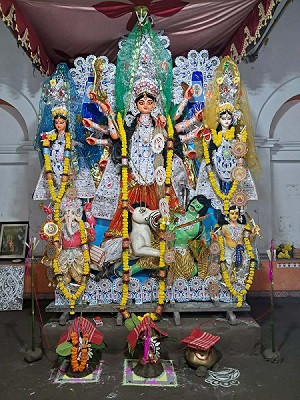
Howrah, October 12: At a time when Durga Puja celebrations across Bengal continue to evolve with changing traditions, the historic Dutta Chowdhury family of Andul in Howrah remains committed to preserving centuries-old rituals. Among the most distinctive customs of this ancestral puja is ‘Shatru Bali’, a symbolic offering performed on Vijayadashami in place of the traditional animal sacrifice associated with certain Shakta traditions. More than four and a half centuries after the puja was introduced, the family continues to observe its inherited customs, making it one of the region's notable traditional Durga Puja celebrations.
Historical manuscripts and family records trace the origins of the puja to 1568 AD, corresponding to 975 Bengali era and 1490 Shakabda. A board displayed in front of the family's traditional Thakur Dalan also records the year in which Ramsharan Dutta is said to have established the worship. According to the family tradition, the puja has continued uninterrupted through generations. In 2026, the ancestral celebration marks its 459th year, reflecting the family's enduring connection with Bengal's cultural and religious heritage.
Dhruva Dutta Chowdhury, the 11th-generation descendant of Ramsharan Chowdhury, recounts the family's history, which goes back several centuries before the beginning of the Durga Puja itself. According to him, around 1380 AD, during the reign of Bengal Sultan Sikandar Shah, their ancestor Tekri Dutta received the title of ‘Chowdhury’ for his role in revenue collection in the then Muzaffarpur pargana and became its administrative head.
Tekri Dutta subsequently left the family's ancestral residence at Baligram, associated with the Dutta family of Bali belonging to the Bharadwaj gotra, and settled in Andul on the western bank of the Saraswati River. There, he is said to have undertaken social reforms and established a palatial residence along with religious endowments. This marked the beginning of the Dutta Chowdhury family's history in Andul.
Chowdhury Ramsharan Dutta, the sixth descendant of Tekri Dutta, later introduced the family's Durga Puja. Bengal was passing through a turbulent period under Pathan rule, and, according to the family's historical account, Portuguese and Arakanese pirates frequently raided settlements along the Saraswati River, leaving local residents vulnerable to repeated attacks.
Amid these difficult circumstances, Ramsharan Dutta is believed to have established the Durga Puja on the advice of the family's spiritual preceptor. The worship was regarded as a grand religious observance carrying spiritual significance comparable to that of the Ashwamedha Yajna. Over the centuries, the puja became an integral part of the family's identity, with successive generations preserving its distinctive customs and ceremonial practices.
The presiding deity of the Dutta Chowdhury household is Mahishasuramardini Durga, worshipped here as ‘Rajarajeshwari’. The idol, its decorations and the elaborate backdrop, known as the chalchitra, distinguish this puja from many other traditional celebrations in Bengal. The family follows the old ‘Tanachouri’ style in constructing the deity's decorative backdrop, preserving an artistic tradition passed down through generations.
Each part of the chalchitra carries its own distinctive imagery. The backdrop associated with Goddess Lakshmi features a depiction of Goddess Jagaddhatri, with a small idol of Goddess Jaya placed above it. The backdrop of Goddess Saraswati portrays Dakshina Kali, while Goddess Vijaya occupies the upper position. The central backdrop of Goddess Durga features an image of Ananta Vishnu, with a meditating idol of Lord Shiva placed at the top.
The iconography of the deities also reflects the family's distinctive artistic tradition. The lion serving as Goddess Durga's mount is fashioned in the shape of a horse, while Lakshmi and Saraswati stand on lotuses. These unusual features give the idol and its decorative arrangement a unique identity within the region's traditional Durga Puja heritage.
The architectural history of the family's place of worship is equally significant. The puja was initially held in an atchala temple, a traditional Bengali structure characterised by its distinctive roof design. Around 1630, the original structure was replaced by a permanent Thakur Dalan built of brick, replacing the earlier atchala structure made with brick and thatch. The present Thakur Dalan was reconstructed in 1930. Four Shiva temples stand beside the main worship complex, two of which follow the traditional atchala architectural style.
One of the most remarkable aspects of the Dutta Chowdhury family's Durga Puja is the blending of Shakta and Vaishnava traditions, particularly during Vijayadashami. The family follows the rituals associated with the Brihat Nandikeshwar Purana while also observing Vaishnava customs, creating a distinctive combination of religious practices.
The tradition of ‘Shatru Bali’ is perhaps the most unusual feature of the celebration. Instead of animal sacrifice, a small figure is made from rice flour and symbolically sacrificed to represent the defeat of enemies. The ritual is intended to signify victory over adversaries rather than involve the killing of an animal. Offerings of ash gourd and sugarcane are also made as part of the family's ceremonial observances.
Another important ritual takes place on Maha Navami, when Dhunochi burning is performed following the Kumari Puja. These practices, along with the family's distinctive Vijayadashami customs, remain central to the celebration and are carefully maintained as part of its inherited religious traditions.
On Vijayadashami, after the women of the household perform the traditional boron ceremony for the goddess, the idol is taken in a procession to Dule Para. Women from the neighbourhood then perform another round of ceremonial greetings and welcome rituals before the immersion of the idol. The participation of women from both the family and the local community adds another dimension to the longstanding celebration.
Food offerings are also an essential part of the puja. Rice-based bhog is offered to Rajarajeshwari on Saptami, Ashtami and Navami. The family also preserves an unusual ancestral expression associated with the distribution of prasad among its present members: ‘Baba, Ramsharaner korai dhor’, a phrase that continues to be repeated as part of the inherited household tradition.
The family's culinary heritage includes ‘Agamonda’, a traditional Bengali sweet that is now considered rare. Prepared with khoya, coconut, sugar and dry fruits, the delicacy is a special feature of the family's Durga Puja celebrations. Its continued preparation reflects the family's efforts to preserve not only religious rituals but also traditional food culture.
For the Dutta Chowdhury family of Andul, Durga Puja is far more than an annual religious celebration. It represents a living link with the family's history, Bengal's traditional architecture, distinctive artistic practices and a centuries-old blend of religious customs. From the worship of Rajarajeshwari and the symbolic ‘Shatru Bali’ to the rare Agamonda sweet, the 459-year-old puja continues to preserve a remarkable cultural legacy in Howrah.
You might also like!