Durga Puja 2026: The Mistake Behind the End of Animal Sacrifice! The Story of a Priest’s Untimely Death and the Unique Bhog Still Offered at a Bardhaman Puja
IIE DIGITAL DESK ; Kolsara, Purba Bardhaman, October 14: The mysterious legend, a divine vision and centuries-old family traditions have made the Durga Puja of the Ghoshal family in Kolsara village of Jamalpur, Purba Bardhaman, a distinctive part of Bengal’s festive heritage. According to family tradition, the worship began in 1655 after Ishwar Chandra Ghoshal received a divine vision of Goddess Durga in the form of a young girl near a secluded banana plantation. The family has continued the worship with devotion for generations, preserving rituals and customs that set its Durga Puja apart from many others. Among the most intriguing stories associated with the puja is the account of how animal sacrifice was discontinued following a mistake involving the ceremonial cannon announcement at Bardhaman’s Sarbamangala Temple and the subsequent untimely death of the family priest.
The family’s traditional account, Ishwar Chandra Ghoshal once saw a young girl in a quiet banana plantation. When he approached her, the girl suddenly disappeared. That night, he is said to have received a dream in which the goddess instructed him to begin her worship. Believing that the girl he had seen was Goddess Durga herself, Ishwar Chandra initiated the family’s Durga Puja in 1655. Since then, the tradition has continued uninterrupted, passing from one generation to the next.
The memory of that divine encounter continues to shape the rituals of the puja even today. As the goddess was believed to have appeared in a banana plantation, banana, banana stem and banana blossom hold a special place in the offerings made to her. These distinctive ingredients are used to prepare the bhog, giving the family’s Durga Puja a unique culinary tradition closely connected with the legend of its origin.
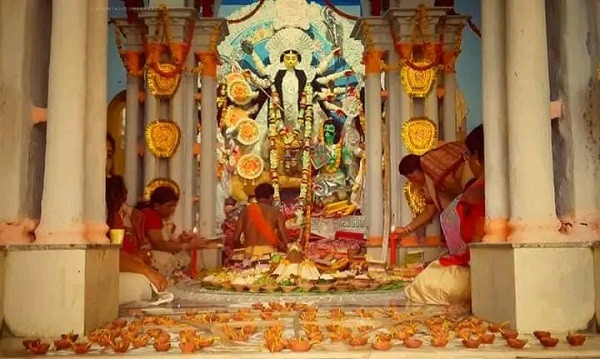
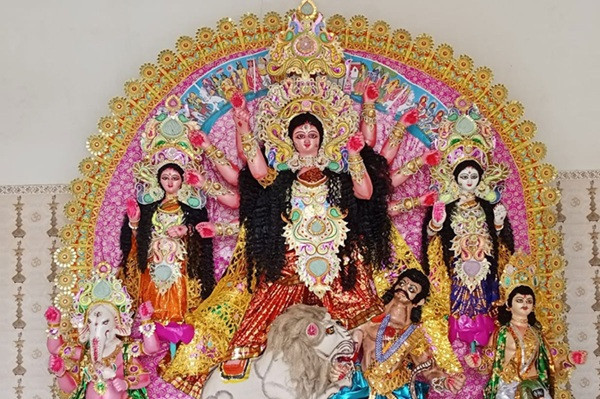
Preparations for the annual worship begin well before the main festivities. On Janmashtami, work starts on constructing the framework of the goddess’s traditional ekchala idol at the family’s thakur dalan. In an ekchala arrangement, the goddess and the associated deities are presented together on a single backdrop. The idol is decorated in daker saaj, a traditional style of ornamentation associated with Bengal’s heritage pujas.
The formal worship begins on Pratipada and continues for nine days. From Mahalaya until Dashami, the goddess is offered bhog prepared with banana, banana stem and banana blossom. Another distinctive feature is that Ganga water is used in cooking these offerings, reflecting the family’s emphasis on maintaining the traditional religious practices associated with the puja.
Samir Ghoshal, a member of the present generation of the family, has said that their ancestors were descendants of the royal family of Bhukailash. The family’s history in Kolsara is also linked to the period of Sher Shah Suri. According to the family account, Digambar Ghoshal, an ancestor of the present family, was a trusted employee of Sher Shah. In 1540, when work on the Grand Trunk Road was under way, he was reportedly sent to the area to supervise the construction. The Ghoshal family subsequently settled in Kolsara, and Digambar’s great-grandson, Ishwar Chandra Ghoshal, later established the family’s Durga Puja.
One of the most unusual chapters in the history of the worship concerns the end of the animal sacrifice tradition. The family’s account states that sacrifices were once performed after the sound of the ceremonial cannon at Bardhaman’s Sarbamangala Temple. The cannon served as a signal for the ritual, and the Ghoshal family followed the practice as part of its traditional worship.
However, an unfortunate misunderstanding is said to have brought the practice to an end. Many years ago, firecrackers were reportedly set off in a nearby village before the cannon was fired at the Sarbamangala Temple. Mistaking the sound for the official signal, the family proceeded with the animal sacrifice.
The mistake became apparent when the actual cannon sound was heard shortly afterwards. According to the family’s account, the priest took responsibility for the error. Within a few days, he died an untimely death. The incident left a lasting impression on the family, and animal sacrifice was discontinued at the puja from that time onwards.
The story has since become an important part of the oral history surrounding the worship. While the incident is preserved through family tradition rather than independently established historical evidence, it remains closely associated with the decision to abandon the sacrifice ritual.
Today, the Ghoshal family’s Durga Puja in Kolsara is remembered not only for its long history but also for the customs that have survived across generations. The divine vision associated with Ishwar Chandra Ghoshal, the special bhog made from banana and other plant ingredients, the use of Ganga water and the distinctive Dashami ritual of worshipping 11 young girls, known as Kumari Puja, continue to define the celebration.
Durga Puja 2026 brings families and communities together across Bengal, the centuries-old worship in Kolsara offers a glimpse into the state’s rich heritage of household pujas. Its traditions blend religious devotion, local folklore and family history, preserving a story that has endured since the seventeenth century. For the Ghoshal family, the annual celebration remains a living link to its ancestors and to the beliefs that shaped the beginning of the worship nearly four centuries ago.
You might also like!