CM Suvendu Adhikari | ‘We Need Self-Reliant Bengal, Not Allowance Dependence’: Chief Minister’s New Message from Haldia
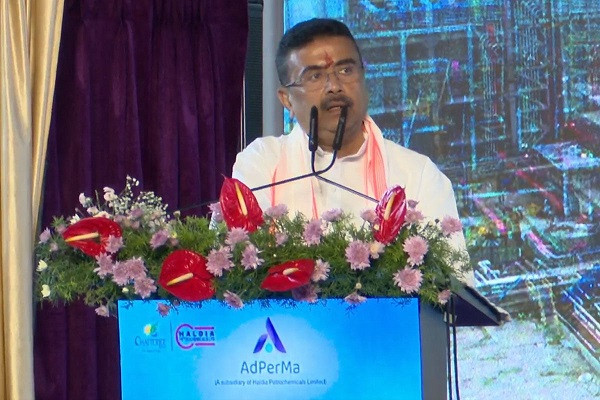
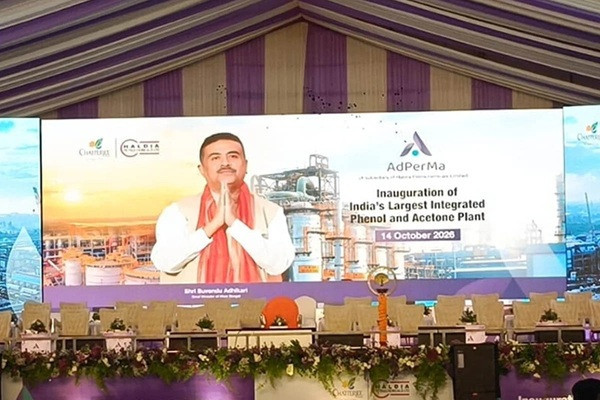
IIE DIGITAL DESK ; Haldia, October 14: West Bengal Chief Minister Suvendu Adhikari on Wednesday inaugurated a major industrial project worth around ₹6,000 crore in Haldia, signalling the state government’s renewed push to attract investment and expand manufacturing. The new phenol and acetone production facility, developed by Adparma Private Limited, a wholly owned subsidiary of Haldia Petrochemicals Limited, is being viewed as a significant addition to the state’s chemical manufacturing sector. Addressing the gathering, the Chief Minister called for a self-reliant West Bengal, arguing that the state must move beyond dependence on financial allowances and create more opportunities through industrial growth and employment.
The inauguration took place on Chaturthi, on the banks of the Haldi River, as the state government sought to highlight fresh industrial investments ahead of the Durga Puja festivities. Adhikari arrived in Haldia before noon, accompanied by state Industries Minister Tapas Roy, Transport Minister Arjun Singh, Chief Secretary Manoj Kumar Agarwal and other dignitaries. During the visit, the Chief Minister inspected the plant and offered prayers at a temple located within the facility. He subsequently inaugurated the project by cutting a ribbon and lighting a ceremonial lamp.
Speaking at the event, Adhikari asserted that the momentum of industrial development in West Bengal could not be stopped. He expressed confidence that the state would move forward with the support of what he described as a “double-engine” government and said more investments were expected in the coming years. According to the Chief Minister, investment proposals worth another ₹10,000 crore are in the pipeline. He also credited Haldia Petrochemicals with playing an important role in demonstrating the state’s industrial potential.
The newly inaugurated facility is expected to expand the production capacity of phenol and acetone, two important industrial chemicals used in several manufacturing sectors. The project has set production targets of 345 kilotonnes per annum (KTPA) of phenol and 215 KTPA of acetone. These chemicals are essential raw materials for industries such as pharmaceuticals, paints, automobiles, electronics and other manufacturing activities. Increased domestic production could help improve the availability of these materials and reduce dependence on imported supplies.
Adhikari linked the project to Prime Minister Narendra Modi’s broader vision of Atmanirbhar Bharat, or a self-reliant India. He said West Bengal should follow the same path by strengthening its manufacturing base and creating an environment in which businesses can invest and expand. The Chief Minister emphasised that the state needed to reduce its dependence on financial allowances and focus on building a stronger economy through industrial development.
The remarks also renewed the state government’s focus on the debate over welfare payments and employment generation. Since taking office, Adhikari has repeatedly advocated reducing what he describes as dependence on allowances. The government has discontinued allowances for imams, muezzins and priests, while several other welfare schemes, including Ayushman Bharat and widow pensions, continue to operate. His latest statement places industrial investment and self-reliance at the centre of the government’s economic message.
Alongside the ₹6,000-crore Haldia project, the Chief Minister announced plans for additional industrial facilities in the region. According to his announcement, Pepsi will establish a new plant on 98 acres of land in Haldia, with the Haldia Development Authority having provided the land for the proposed project. Another facility dedicated to manufacturing medical equipment is planned on 50 acres. Adhikari expressed hope that these developments would give Haldia’s industrial sector a further boost over the next year.
The proposed projects are expected to create opportunities for direct and indirect employment, although the actual number of jobs will depend on the implementation and operational scale of the facilities. Haldia has long been an important industrial centre in eastern India, and the latest investment announcements could strengthen its position as a destination for manufacturing, chemical production and related businesses.
The Chief Minister also announced that a trauma care centre for the benefit of workers in Haldia would be inaugurated in June 2027. The proposed facility is expected to improve access to emergency medical services for industrial workers in the region, where large manufacturing units and industrial operations require adequate healthcare infrastructure.
In another major announcement, Adhikari said a Reliance Group plant would be established at Haringhata in Nadia district. The foundation stone for the facility is scheduled to be laid on October 28, according to his statement. He also announced that a Campa Cola manufacturing facility would come up in Haringhata. The announcements form part of the government’s broader effort to attract investments across different districts rather than concentrating industrial development in a limited number of locations.
The government is also pointing to other projects as evidence of its efforts to revive manufacturing in West Bengal. These include the proposed expansion of Lux Cozi’s manufacturing activities, the process of establishing an Amul factory, and plans for a deep-sea port at Dadanpatrabar in Paschim Medinipur. Adhikari has also held discussions with major industrialists, including Mukesh Ambani and Gautam Adani, as part of the effort to bring fresh investment into the state. Adani Group projects in New Town, including a proposed hospital, have also featured in the state’s industrial and infrastructure development narrative.
Industrial decline and a lack of employment opportunities were among the issues highlighted during the political transition in West Bengal. The BJP had promised to restore the state’s industrial standing, and the government is presenting the latest announcements as part of that effort. Whether these projects translate into sustained investment, substantial job creation and wider economic benefits will depend on how quickly they are implemented and become operational.
For Haldia, the inauguration of the new phenol and acetone plant represents a significant investment in the chemical industry, while the proposed Pepsi and medical equipment facilities could further expand the area’s industrial base. With additional projects announced for Haringhata and other parts of the state, the government is seeking to build a wider network of manufacturing centres.
Adhikari’s central message from Haldia was that West Bengal must aim to become economically self-reliant by attracting industries, expanding production and generating employment. The ₹6,000-crore project, the proposed ₹10,000 crore in further investments and the announcements of new manufacturing facilities have placed industrial growth at the forefront of the state government’s agenda. The coming months will show how quickly these plans move from announcements to implementation and how much they contribute to jobs and economic activity across West Bengal.
You might also like!